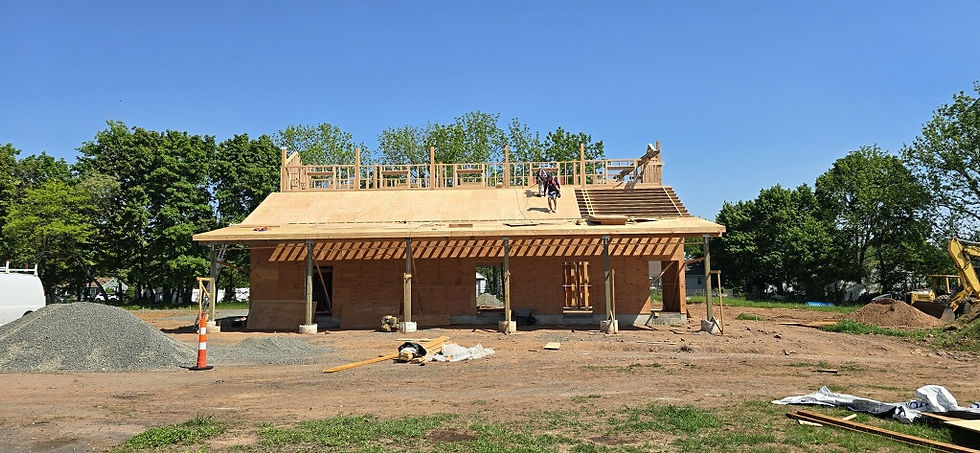
High School Ag-Science Barn on Pleasant Street Nears Completion
Updated: Jul 2

For many decades the property on Pleasant Street next to DePaolo Middle School, which was owned by the Faryniarz family, had a stable. Some locals (including this reporter) remember feeding apples to the horses who lived there while strolling down the sidewalk.
In 2014, the family sold the parcel to the town of Southington, which has managed it ever since as open space. DePaolo’s Garden Club now has a garden and a farm stand on the property, while the school’s Animal Helpers Club helps take care of a chicken coop. The property is also home for some of the town’s community gardens.
While the old stable was demolished some time ago, a new barn is now being constructed in its place. Once it is finished, it will offer students from Southington’s Agriculture Science and Technology program, now housed in the high school, the chance to work with animals in a more pastoral setting – and at the same time, help revive the town’s connection to its farming past.
“It’s really a wonderful way to honor the agricultural heritage of Southington,” said Owen McLaughlin, head of the program, on a recent tour of the site.
According to McLaughlin, the original idea for the project came from School Superintendent Steve Madancy. “This is the idea of our Superintendent. He always thought it would be great for the agriscience program to have a school farm or a land lab. Our current animal paddock space [at the high school] is only about 600 square feet. We were looking to get more space for more animals. I thought it was fantastic idea.”
All of the cost for materials and construction has been underwritten by the State of Connecticut through an Agricultural Science and Technology grant. The grant program was originally implemented to make up for decades of underfunding of agricultural science programs at the state level. It is specially designed to support capital improvements like the Pleasant Street barn.
The timbers and other elements that make up the structure were purchased from a firm named BarnPros in Washington State. The barn is 30 feet wide by 60 feet long and built in what is called ‘western style’ with two wings and a second-story hay loft. The wings, which give it a bird-like appearance in profile, can be used to park vehicles or as teaching areas.
Upon entering the barn from the street, a visitor sees a series of livestock stalls on the right. One of the stalls is designed for equines and has a v-shaped notch in the top of its Dutch door. McLaughlin said that the agriscience program’s donkey and Shetland pony will be moved into the stalls first, followed by one or two small cows, and some sheep and goats. Goats, he said, are an increasingly popular animal, with Bradley Mountain Farm showing some of the creative ways they can be used in a business setting.


Across from the stalls are rooms for equipment and an open space meant to serve as a classroom. There instructors will be able to take the animals out for demonstrations and show students how to handle them.
The second floor consists of a hayloft lit by a row of windows, with a ridge vent that allows air to circulate. According to McLaughlin, every year a contractor will stock the loft with hay using a conveyor belt.

Students will travel from the high school in minivans for classes at the barn. The trip is short enough that students will be able to spend at least an hour on site when they take their classes on large-animal science.
The area outside the barn will also be put to good use. In front of the parking lot, a small apple orchard has been started with trees donated by Rogers Orchards’ Greg Parzych. New fencing will have to be installed in the pasture before the animals can be sent out to it. “There’s 7.55 acres, so we have a ways to go with that,” said McLaughlin. If all goes according to schedule, construction on the barn will wrap up by August 10, with seeding and fence-installation to follow.
Southington’s Agriculture Science and Technology program has about 210 students, according to McLaughlin, 50 to 60 of whom are expected to study at the barn each year. Students can use some of the classes to satisfy their work study experience.
One of the first projects will involve creating signage for the farm. McLaughlin said that he was inspired by the newly renovated farmyard space at Bridgeport’s Beardsly’s Zoo’s, which has lots of informative signage: “This will provide hands on opportunities for students, which we’re really excited about.”