


DePaolo's Palmieri is State Middle School Principal of the Year

The tie and jacket combo, the lanyard around his neck bearing the period schedule for the school’s three grades, the office decorated with mementos and inspirational posters – it's the sort of thing you might expect to see when meeting Connecticut’s Middle School Principal of the Year.
But there’s one thing you might not expect – the box of chicken eggs, freshly gathered from the nest, that he's carrying in his hands.
Just before the Outsider came to interview him, Palmieri had been outside attending to the coup that DePaolo Middle School maintains on the farm property next door. Each day he visits the chickens, usually with a small team of student assistants, to check their water and food and collect any eggs they might have laid. The routine allows Palmieri to teach the kids something about caretaking and responsibility. It also gives him a chance to open a line of communication with the students, and let them experience responsibilities as a source of pride and fun.
“To me this job all about connecting with the kids. I remember every day, it’s kids first. I love that quote up there,” he says, gesturing to a poster on his office wall. “‘Children are not a distraction from the more important work. They are the most important work.’ I love it because everything I do, everything the staff does, has to be student-centered.”
Palmieri does a lot of things of that sort at DePaolo. Some activities have him taking kids across the street to Calendar House to volunteer. Others bring principal and students to the animal shelter on Woodruff Street, or the nursery school at Zion Lutheran. The press release from the Connecticut Association of Schools announcing his honor mentions the students who, under his guidance, participate in running the Apple Harvest Festival.
“The kids are so inquisitive at this age. They’re mature, not quite elementary, but they’re not adults either. It’s a time to help them be what they want to be. I want to expose them to many experiences so they can develop into the people they want to be.”
It was the in-between character of middle school students that originally helped him make up his mind to become an educator.
“My undergraduate degree was actually in business administration. After my freshman year, I started substituting in New Britain, where at the time you didn’t need a degree. I started subbing there, and I started getting a passion for it there. So I knew I liked teaching, but there was a missing piece.”
“When I graduated, I started in the middle schools. And that was the missing piece - teaching middle school.”
One of the main challenges in teaching middle school students is helping them to keep the rush of adolescent energies under control in a way that allows them to think and to learn. Along with its dedication to academics and community service, there is a pervasive focus at DePaolo on emotional learning. For that, Palmieri says he has benefited a great deal from a program at Yale that has pioneered this approach to education.
“We have done a lot with Yale’s emotional intelligence program, which is called RULER. It’s run by Marc Brackett. We’ve learn so much from it.”
On his office wall Palmieri has a Mood Meter poster that he uses each day with the students in his advisory group. According to the RULER website, the purpose of the Mood Meter is to “enhance self- and social-awareness and support the development of a nuanced emotion vocabulary and a range of strategies for regulating emotion.”
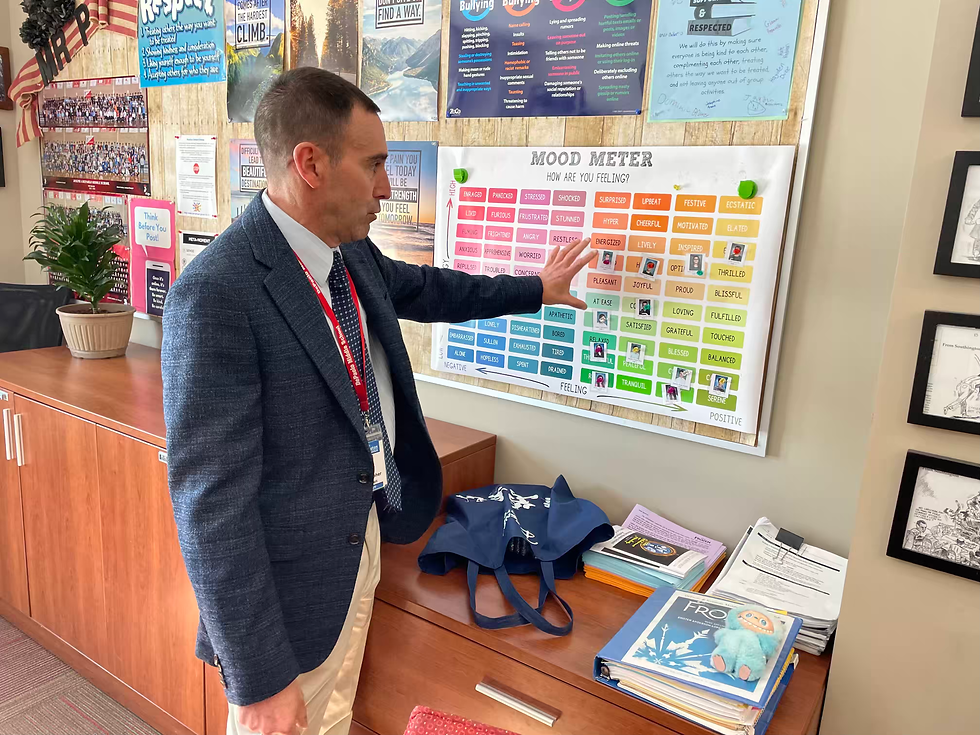
Emotional intelligence is not just something students work on individually. Classroom groups, and even the entire school have sought to articulate how they want to feel – and by extension, how they want to be treated – when they are at school. Everyone from students to teachers and administrators takes part in creating it, and thus everyone has a stake in seeing it work.
“We came up with a charter which asks, how do we want to feel when we are together? We created the question, and you’ll see the answers in the classrooms. Before they can start their learning, student need to be emotionally in a place where they can learn.”
“I’ll show you when we walk out into the hall the one we did a whole school charter as well. The students and the staff all signed it. It’s a honeycomb, a beehive, like a community.”

After demonstrating the charter, Palmieri made his way to the cafeteria where DePaolo’s 6th grade lunch was underway. The room was just as crowded as a beehive and as loud, with hundreds of students chatting at the tables with their friends. At the entrance there was a constant stream of students coming and going with bathroom-pass lanyards in hand as they took their last chance for a break before lunch ended.
Grabbing a microphone, Palmieri started calling out the names of students who had won rewards for completing an extra-credit math assignment. The dozen or so who were called came up to claim small bags of chips or popcorn. Each one made their way to the front of the cafe, looked their principal in the eye, and picked out their prize before walking back to their tables.
It’s a big school, with 674 young people. Yet in the space of about five minutes, Palmieri had made a connection with another set of students, those who had taken the initiative to do a bit more academic work. It’s part of his constant effort to build bridges from the world of childhood to the world of adulthood, and invite students to cross it – an effort for which he has now been recognized.


