At Sikh Temple, A Close Community Has Open Doors
- Philip Thibodeau
- Feb 25
- 6 min read

Every Gurdwara, or temple, built by the Sikh religious community has four doors, one on each side of the building. This tradition is meant to signify that people from every corner of the world are welcome to enter.
The Gurdwara Guru Nanak Darbar at 1610 West Street in Southington – the largest such structure in New England – is no exception. Anyone is welcome to come in. Those who do so are also invited to share in the community meal or to enter the prayer hall while hymns are being recited and music played. If you want, said our host Kanwaljit Singh, you can go behind the priest at the front of the hall and take pictures of whatever you see. “We just ask that you do two things,” he says. “Take off your shoes – the floor is warm, don’t worry – and put a cover on your head, as a sign of respect.”
On the right as you enter, just past shoe and coat rooms, is the Gurdwara’s spacious community hall. Inside are long carpets spread out on the floor, a few tables along the walls, and a kitchen area. On a recent Friday evening, children and teenagers were occupying two of the tables, some drawing, some studying Punjabi – the language of the Indian province of Punjab, from which most of the founders of the Sikh community emigrated:

One young woman was at work on a picture of a lion. Every Sikh man, she explained, has the name Singh, which means ‘lion’, as part of their name. And every Sikh woman has the name Kaur, which, she said, means ‘warrior-princess’. The tradition goes back to an early Guru - a Sikh saint or teacher – who wanted members of the religion to reject the caste system and be treated as equals, regardless of family background:

Most members of the community sit down to eat on rugs on the floor. This way, Kanwaljit explains, every one is on the same level, equal before God; men and women are all equal too.
“Of course, some of the old people, they don’t have great knees to get down on. So they can go sit at the tables,” he said, before explaining the meal options.
Waiting on the kitchen counter are big bowls of chickpeas, curry, cabbage, and rice. Other choices include a piece of naan flatbread, or some pickle relish spicy enough to make the winner of a hot-wings eating contest wince. Sides of yogurt sauce and rice pudding ensure that no one departs hungry:

Providing food for each langar or common meal is the responsibility of local families, who take turns performing the service. There are roughly 50 Sikh families in Southington, and hundreds more throughout central Connecticut. The Gurdwara, originally built in 1999, was expanded in 2011 to accommodate the growing community.
Everyone is happy to talk to a visiting reporter, and identify their professions: mechanical engineer, electrical engineer, teacher's aid, truck driver, physician, neurologist, and gas station owner. The current president of the community, Kulwant Singh Samra, came to the United States in the 1980’s. He bought a gas station, and currently owns the Gas-and-Go on Queen Street. He is shown in this photo sporting a long white beard:

The younger Sikhs have typical young people concerns. What are you planning to do this weekend? “Catch up on sleep,” says Ikleen Kaur. “Physics homework,” says her cousin Gurjaaj, a senior at Southington High.

Sometimes the stories people share are less typical. After dinner, Kulwant’s wife Kulwinder described how, when she was twenty years old and going to school in India, she killed a cobra that slithered into the school yard by hitting it in the middle with a large stick: “not the head, not the tail, the middle.” She said her teacher looked in shock at the dead snake, and scolded, “What do you think you are doing [taking such a risk]? Don’t you know you are your mother’s only daughter?”

A Short History of the Sikhs
The Sikh religion was founded in Punjab by a succession of holy teachers or Gurus who claimed divine inspiration. The first, Guru Nanak, was a contemporary of Christopher Columbus; the tenth, Guru Panth, passed away in 1708. The early Gurus worked out the central principles of Sikh life and worship, while the later Gurus developed ideas about social organization as they steered their fledgling community forward. Sikh culture respects and resembles Hindu and Muslim cultures in some ways, but they see themselves as following an alternative path, newer and more universal.
For about three hundred years, the Sikhs were a religious minority in Punjab, frequently persecuted by its Muslim rulers. Then, from 1799 until 1849, Sikhs got the upper hand and maintained a Punjab empire.
After India won its independence from Britain in 1947, Sikhs began to come into conflict with the new Hindu government. This conflict reached a head in 1984 when Prime Minister Indira Gandhi ordered the army to take over the Golden Temple, the Sikhs’ most sacred shrine. In the fighting that followed, thousands died. Later that same year, Gandhi was assassinated by two of her Sikh bodyguards, an event which touched off riots that saw thousands more Sikhs killed.
To escape the violence, Sikhs began emigrating in greater numbers to various countries, including the United States. They have been welcomed here, though with occasional, unsettling exceptions. “If I meet 30 guys,” said Kanwaljit, “one guy will not like me because I wear a turban. Often they think I am Muslim, even though Muslims do not wear the turban. What can you do?” With visible pride, he referred to the achievement of Swarnjit Singh, who was recently elected mayor of Norwich, Connecticut

At Worship
Sikhs believe that in addition to the ten human Gurus, there is an eleventh, eternal Guru named Guru Granth Sahib. To the eye, the Guru looks like a large, handwritten book, 1,430 pages long. But it is part of Sikh religion to treat the sacred book as a person – as a king in fact. The Guru Granth Sahib is tucked into bed at night to sleep, and carried out at dawn to a couch on a canopied platform.
Every day a random page is opened; the first full verse on the page is copied out and posted for visitors to the Gurdwara to read and contemplate.

Much of the Sikh service consists of the singing of hymns to musical accompaniment and the recital of the text of the Granth. During the recitation people come and go; men sit on the right, women on the left. From time to time, someone will approach the platform to request a blessing and leave a cash offering.

Before the platform sits a row of old-fashioned weapons, including a round shield and several throwing rings. They are symbols both of divine strength and human duty. “The weapons tell you that you must protect your family from an attacker,” Kanwaljit said. “But not just your family. If you see any weak person being harmed by a strong person, you must protect them too.”
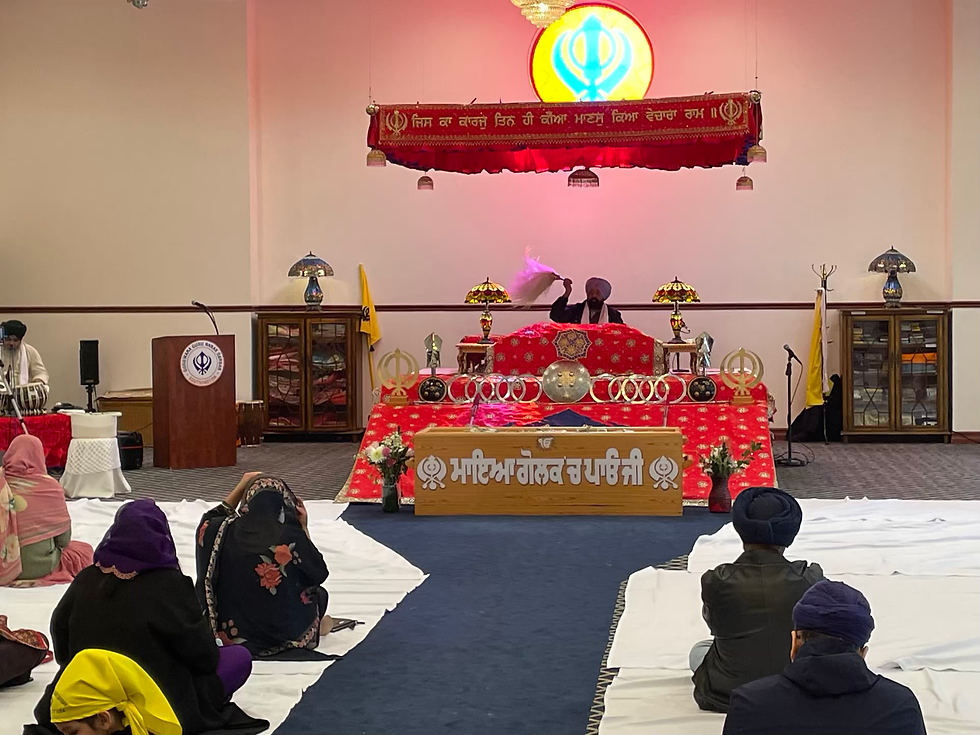

While hymns from the Guru Granth are sung, musicians play hand drums called tabla, and the harmonium, an accordion-like keyboard instrument. The instrumental music and the singing, which are together called kirtan, are meant to bring community members into an emotional and spiritual union with God:
Community Service
According to a booklet of Guru Nanak’s wisdom called the Japji Sahib, there are three fundamental principles of Sikh religion: “to remember God through meditation; to earn one’s livelihood through creative, productive, and honest labor; and to share the fruits of earnings with the needy.”
Like many religious communities, Sikhs regard giving and service as essential components of the devout person’s life. Kanwaljit, along with other members of the congregation, is constantly fundraising and donating; currently he is working to set up a scholarship for students at Southington High School, and one for students back in India.
Sharing one’s talents is another form of giving. As the Outsider was leaving the Gurdwara on Friday evening, two teenagers did just that, offering an impromptu musical performance in the coat room: