


- Philip Thibodeau
- 5 days ago
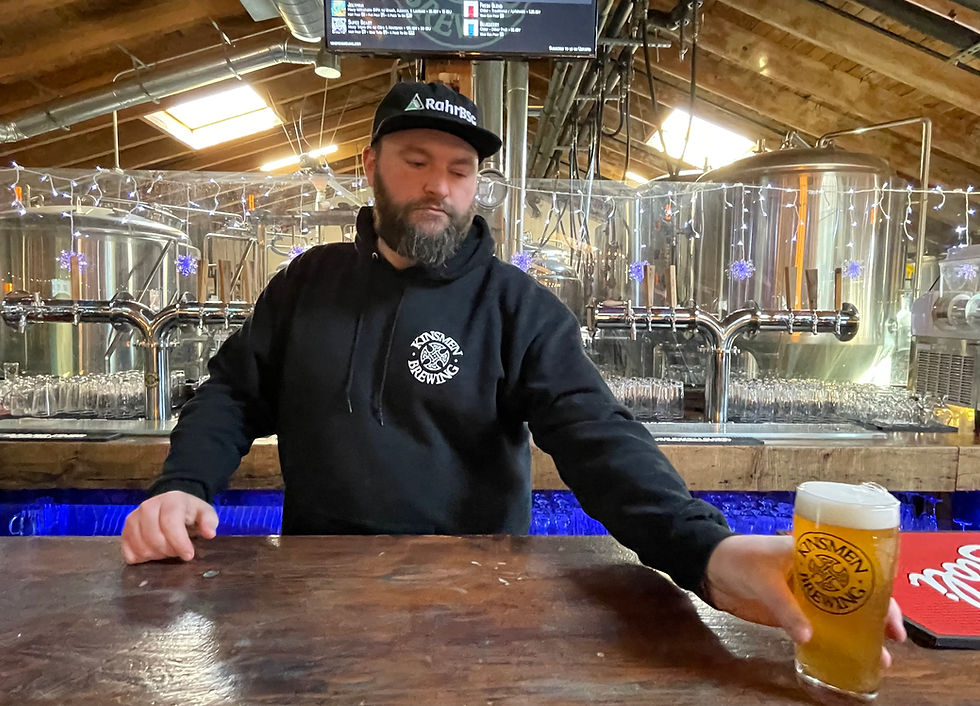
Note: this is the third in a three-part series on Southington’s breweries. For the first two installments in the series, click here and here.
Situated in the former Clark Brothers Bolt Factory building at 409 Canal Street, Kinsmen Brewery has one of the larger customer spaces in the state, with a large banquet hall, a cavernous taproom, and two outdoor seating areas. A visitor might come for a beer and not even know that the facility was hosting a wedding and a birthday party at the same time. It also offers customers a range of pizza options to go with its beverages through a partnership with Sauced, the on-site pizzeria run by the creators of Domenic & Vinnie’s.
Yet at Kinsmen, size does not mean compromising on quality. The thirsty visitor soon discovers that each of the beers on tap has a distinctive taste and character, the product of careful craftsmanship. The man who is most responsible for that craft is head brewer Jonas Griggs. Griggs may be relatively new to Kinsmen, but he brings a wealth of knowledge and experience to the job. He sat down with the Outsider back in February to talk about Kinsmen’s approach to brewing and the challenges and rewards of the business.
How would you describe your role here at Kinsmen?
Greg [Caucci] and Bruce [Staebler] have been the owners of this place for the whole time. I’ve come on board over the past 15 months or so. I’m relatively new to the business, but I’m not new to brewing, and when their last head brewer was going off to his next adventure, I applied.
I deal with day to day operations of the brew house, and I help out at the tavern sometimes, though we have a general manager who handles that. My job is to make sure that the beer quality stays the highest that we can make it, that we’re using the best ingredients, that the inventory is always running, making sure everybody’s schedules are running right, and that we have a constant full tap with a ton of variety so we can give something to everybody.
What are your best sellers?
It’s funny to say, but we’re seeing a resurgence in lagers. I think lagers have always done pretty well, and at Kinsmen Cold Gold is usually the flagship, the one we have on tap most often. It’s an American light lager with rice and corn in it. Lagers are making a big comeback. They’re not fully where IPA’s are yet – the IPA trend is not going anywhere anytime soon. If you were to look at sales, New England IPA as a category would be a bigger seller than the lagers. But if you’re looking at single beers, Cold Gold is definitely up there.
We run a number of different flagship IPA’s, like Yup/Nope double IPA. Our single IPAs, whether 21.3 or Deckside, are also huge sellers for us, closer to 6.5 % [alcohol content]. Between the lagers and the New England IPA’s, they’re at the forefront of everything.
Tell us about your heavier beers, your stouts and your porters.
We love having as many varieties on as we can, and we do love dark beers back there at the brewhouse. We did recently have a variety called Trunchbull’s Punishment, which is a reference to the movie Matilda; it’s a German chocolate king stout, 10 percent. We also stored some of that in 1792 barrels that aged for about a year.
But as far as dark beers that are going, we have a gingerbread stout that’s about ten percent, we have a doppelbock which is 7.8 percent, and then we have a Czech style dark lager at 5.6 percent. So we have a few dark options ranging through all different kind of tastes.
We also have Super Beast which is a 10 percent, triple IPA. We’re not afraid of doing headbangers, and they tend to sell pretty well too.
We like to have at least some IPAs, at least some light options, some dark options, and a sour option. In summertime we push towards multiple sours, two at once time. During winter, people tend to stick to IPA’s, lagers, and stouts. The stouts drop off and sours take over as the weather warms up.
What are some of your personal favorites?
My personal favorite right now is the dark lager, Bring on the Darkness, a Czech dark lager. We also have a modern West Coast style pale ale which is crisp, clean, bright; it uses an old-school hop to give you a taste of West Coast bitterness, the resinous flavor, but then also a bit of juicy fruitness as well. It’s the little sister beer to our West Coast IPA, Sucks to Suck. That one is called Fairly Sucks.
Who names these beers? You? Your whole team?
Yeah, we have to sit back there and, for lack of better words to describe it, it’s whatever we think is going to make somebody smile when they order at the bar. That’s where we go with a lot of our naming. If you can make one out of ten people chuckle at a name, it’s worth it. Then they’re more apt to tell their friend, oh, I had a Fairly Sucks. Sometimes we go more serious, but for the most part we keep it lighthearted.
You also have some low alcohol options. I was surprised at that.
Right now we have a NA [Non-alcoholic] – 0.5 percent or less is considered NA – called Clearhead. It’s a non-alcoholic pale ale with hops and grapefruit in it. We try to keep non-alcoholic beer year round at this point because the customer base is there, and they feel more welcome when they show up. Some people don’t drink. I have friends who don’t drink, even being in this industry. Being able to have a place to come and hang out and feel welcome and order a beer at the bar – it’s great for that. To be honest, I mix those in all the time. I think it's one of the best NA’s I’ve ever had, and I have tried a lot of them. I think we really nailed it. They’re not easy to do, and I’ve had a lot of bad NA’s.
How do you intervene in the process to keep the alcohol out?
Basically, you are arresting fermentation with temperature and pressure. We don’t have the technology for a pasturizer in-house, so we do our best to kill the propagation of yeast. We do that both in the fermentation and in post-fermentation where are actively putting in additives to make sure that fermentation doesn’t keep going. You are trying to make sure the acidity is right and you don’t want any bad bacteria. The last batch tasted great the whole way through. This batch tastes great and hopefully we will do a witbier that will have black pepper and fresh orange peel.

Let’s talk about the pricing. Have you had to raise prices in the past year or so?
Yeah. Across the board, I don’t think you can find a brewery that hasn’t raised prices on things. I remember the days of going into a brewery and getting a double IPA for six dollars. Those days are behind us, unfortunately. It’s a shame. I’ve thought about having a five dollar lager pint, just to have one option under six. But our beer sells pretty well at our prices and I think people understand the quality of what we are producing here. They’re not just paying for a beer, they’re paying for an experience when they come in here.
Raw materials, packaging, everything goes up. We get hit with a lot of those costs and we don’t always reflect it to the customer. We’re trying to maintain our customer base, but you have to make sure your product is profitable.
Do you distribute?
We currently only distribute one brand, and that’s Husky Hops, for the UConn Huskies. Otherwise everything gets sold right over the counter, which is a good problem to have. We prioritize draft lines over can lines, but we’ve got eight different can varieties to go. That’s pretty good for a brewery our size. We do 1,000 to 1,200 barrels per year.
What’s behind the choice of the name ‘Kinsmen’?
It’s basically a Gaelic/Celtic thing. It’s a theme the owners have run with. It’s about being rustic and homey and a second living room for people. To be a welcoming environment for all, in an old factory, to make it feel cozy.
We’re one of the few breweries in CT that has a fireplace that’s often going. It’s an atmosphere that can’t be replicated very easily. The naming, the design, the tap handles – a lot of it is made of reclaimed wood from the premises. Kinsmen embodies a welcoming atmosphere and being able to do everything from beer to cocktails to pizza. It’s an easy place to come into. It’s a nice spot.
You have a lot of community events going on.
Yeah, we just had a Club Pilates event. Tonight we’ve got a cover band playing, Blondie and Bowie, sold out. That will pull a good number of people in here. Fridays and Saturdays are good for us. We’ve maintained an environment that people like coming back to. We have a full experience, not just the beer.
Do you feel like the Canal Trail out back is an asset?
Huge. That’s why we’re dying for the weather to give us a break here. During the summer, I can clock out of work at the end of my shift and sit out back, and the number of random people that weren’t planning on stopping in that get off their bikes, grab a bite to eat, get on their bikes and keep going is amazing. At the last brewery I was at, the walk-in traffic was non-existent. You didn’t have people dropping in, it was all calculated drives and calculated visits. So it’s refreshing to see that and the trail lends a lot to that.
Do you feel like you have a good relationship to the town?
Yes. It’s slow to build those relationships, but I visit spots around here – get my breakfast around here, go with friends to Groggy Frog, go to Queen St. I’m friends with the guys at Witchdoctor too, so I’ll pop over there, trying to make connections wherever I can. I’ve got two young kids at home, so I don’t have a whole lot of time.
What’s the biggest challenge for you on a daily basis?
I think the biggest challenge for any brewer in this industry is innovation. Tryng to make something that’s putting you more on the map. Trying to do a certain style better than anyone else. We’re always trying to experiment with something new, to find out how to do something in a different way, add different ingredients, ferment in a certain way, change temperatures, even changing the [alcohol] percentages on our flagship beers a little bit.
I think innovation is our biggest challenge, and because you’re in a market that so saturated, it’s often hard to make yourself the shiny pebble in the pile. We do think pretty hard about that stuff and sometimes it’s hard to be innovative while keeping with your core brands. You can’t change your core brand too much. You may pump out a new batch that experiments with it in one way, but you won’t know the results of it for two or three weeks. Yeah, innovation is the hardest thing to do right now to make sure you stand out in the crowd.
Aside from the paycheck, what is the most rewarding thing about this job?
I have referenced this so many times in my life that my wife would probably kill me if she heard me say it. But my favorite Mark Twain quote is, if you do something you love for a living, you’ll never work a day in your life. I love what I do. I get to come to work and create something and see people enjoying it. I’ve worked at a number of different breweries in the state now, and I don’t think I’ve ever had such a direct view of the volume of people enjoying my beer. On a Friday night I work in the taproom, and you can look across the room and there’s hundreds of pints out there – glasses filled with a product that we’ve put our blood, sweat, and tears into.
And because of the way the taproom is shaped, it’s vast, like a cavern. There’s something very rewarding about seeing hundreds of people there drinking your beer and having a good time. The last place I worked at gave me the opportunity to hone my recipe-making skills, but the taproom never got that busy. Here you can see people enjoying the beers. I used to cook for a living and see people enjoy the food I was cooking. This is that, but I have more of an investment of my heart with it. Even recipes that existed before I was here, I’ve put my touch on that, to improve on that. I think that’s the most rewarding thing, being able to come in here and brew beer for a living.
I’ve got a lot of buddies who hate their jobs in front of computers. I have to sit in front of a computer now and then, but for the most part I’m on my feet, moving around, problem solving. It’s really hard to imagine doing anything else than this, which I’ve been doing for ten years now. I love coming to work.
Finally, let’s say you’re at home and you want something to drink. What’s in your fridge? What do you pull out?
Short pours of cans that are here from packing days (laughs). No, if I was going to reach for a beer, my favorite beer of all time is Sierra Nevada Pale Ale. It’s consistent, it’s got a great flavor, I know what I’m getting every time, it’s my favorite brewery ever. It’s an easy drinker, but it still harkens back to the days when I could drink double West Coast IPAs and be fine. Now I can’t drink too many IPAs; it hurts too much the next day. Something at 5.5 percent, that’s right in my wheelhouse and it’s got the flavor that I look for.
Its either that or a nice clean lager – if I can find one, especially one made locally, from someone who makes it well. A problem though is that we pour so much effort into lagers that I can’t always enjoy lagers unless they’re our own!


